Long before snowmobiling became a high-tech, high-horsepower winter sport, it was a lifeline to freedom. For Gary Ilminen, that freedom arrived in the winter of 1969–70 aboard a modest little Olympique. What had once felt like a long, confining season suddenly opened into crisp air, throttle response, and the intoxicating sense of possibility only a sled can deliver. From those first formative rides to witnessing the raw fury of racing legends at the Ironwood Olympus, Ilminen’s life has been shaped by engines, snow, and the relentless pursuit of performance.
Over decades, he has worn many helmets: racer at heart, mechanical designer in training, RN and paramedic by profession, gear reviewer by passion. He has shaken hands with icons like Yvon Duhamel, restored vintage machines, set a motorcycle land-speed record, and returned to riding after a frightening health setback. Through it all, he maintains a deep respect for all things snowmobiling and was happy to share his story.
What is your happiest memory of riding your 1969 Olympique?
I had many happy hours spent on the Olympique, but probably among the happiest were the very first rides I took on it in the winter of '69-'70. Learning the feel, handling and sense of freedom it gave in the midst of what once was for most of my young life a rather dreary, confined-feeling season of the year. Other than downhill and cross-country skiing, out in the countryside where I lived winter was often a long, cold slow season. The little Ski-Doo changed all that very quickly!
That early exposure to racing clearly left a mark. How did attending the Ironwood Snowmobile Olympus shape your lifelong passion for motorsports?
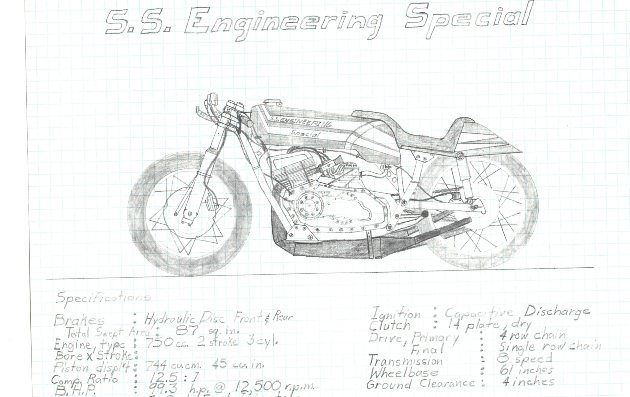
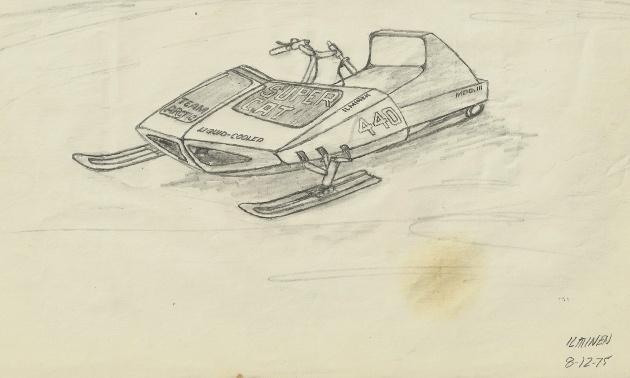
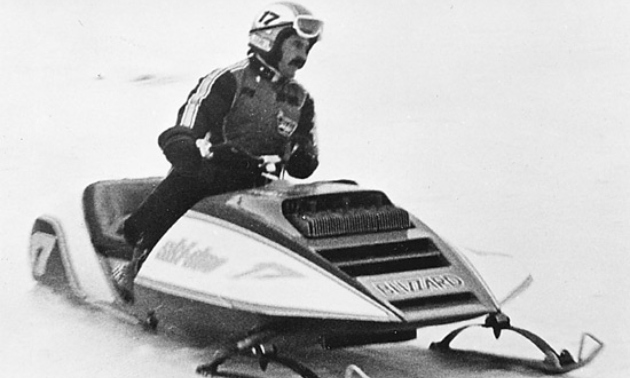
The Olympus brought me in contact with extreme racing machines and the remarkable—some may say crazy—people who raced them. I first heard the otherworldly howl of a Ski-Doo 797cc two-stroke triple cylinder Blizzard and four-cylinder two-stroke Arctic Cat King Cat at the Olympus—and I was hooked! Indeed, my first college degree before becoming an RN and EMT/Paramedic was in mechanical design. I was going to design and build the fastest, most radical racing sleds and bikes ever conceived. Well, I never got past sketches and concept drawings for my sled and bike ideas (some samples attached), but about forty years later, I did set a land speed record on an old motorcycle!
You were wearing custom-made race gear as a kid—how did that early hands-on creativity influence the way you approach riding and reviewing gear today?
In pattern-making for motorcycle parts or riding gear, the thought process is actually pretty similar, and problem-solving on the leading edge of the design is an important part of the process. When I review gear or parts, I consider how the product designers approached the actual in-use application. In most cases, modern gear and parts design is pretty well thought through; most often, if there are problems it is in the periphery or actual manufacture of the product. For example, riding jackets that are very well designed in general terms, but come equipped with the wrong type of zippers, which quickly fail or riding gloves built with single-stitched instead of double-stitched or high-strength seams with poor seam strength that fail by seam separation in normal use--not to mention in an impact situation. I look for details like that in relation to the price/value equation.
What did meeting Yvon Duhamel mean to you, and how did it impact you as a young rider?
Canada's Yvon Duhamel was one of the greatest riders in pro snowmobile and motorcycle racing of all time. I only got to see him in person in snowmobile racing, but he was internationally known because of his pro racing on the Kawasaki racing team riding the wild and ravenously fast H1R race bikes. His riding style on the 1/2 mile banked oval track at Ironwood was always a little beyond the ragged edge of control; he was absolutely fearless. Many racers called Yvon "the Iron Man" because his riding style led to some hairy crashes on both bikes and sleds--but he usually withstood them all and came back to race on if the machine could do it. On a few occasions, I tried to emulate his style on bikes and sleds, but I quickly realized only a rare few can do what Duhamel did, so my style tended to be more a "slow down and enjoy the view" type. My meeting with him was very brief and basically was a quick handshake, me telling him I was a fan of his racing and saying "bonne chance!"
Interestingly, Duhamel was one of two World Champions of snowmobile racing crowned at Eagle River, Wisconsin in the sixties and seventies that I've met in person. The other I got to know very well as he was the Ski-Doo and Yamaha/Honda dealer in my hometown, Hurley, Wisconsin. Steve Ave won the world championship for Ski-Doo twice in the sixties and took second to Duhamel when he won it in 1970! We had bought our Olympique from Steve's father, Tony Ave, Sr. and I bought both of my first new motorcycles from Steve when he took over Ave's Sport Shop in Hurley.
For riders unfamiliar with Sno-Runners, how does the riding experience differ from modern sleds—both in feel and mindset?
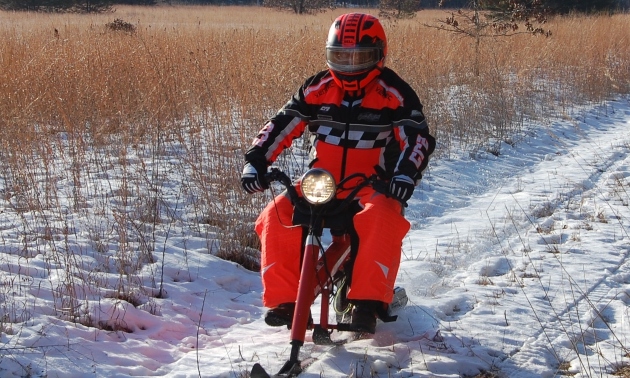
The Sno-Runner only tops out at 30-35 MPH, but even at that, the ride is not too tame. I love the thing because it is an interesting meld of the feel of a motorcycle and snowmobile. It can't do much in very deep powder, but in up to 8 to 12 inches of powder over a firm, smooth base it is able to slalom and ride a crisp line in corners almost like a motorcycle, complete with the leaning of a motorcycle. On the well-groomed trails of today, it is really well-adapted. However, on hard, rutted trails it is very similar to handling a dirt bike in deep sand or a rutted trail. It tends to want to track into ruts, get a little crossed up and be squirrely! I've never been into dirt bike riding, but aboard my Sno-Runner, the ride is loads of fun! Here's one of my videos of the thing soon after I finished the restoration to give you a look.
After a serious health setback, what did it feel like to get back on the Sno-Runner for that first short ride?
It was absolutely amazing and humbling. It felt great to be back on the trail this winter as well as back on my street bikes this past summer! Having worked in healthcare for more than 38 years, and having seen so many people coping with loss of function due to various disabling conditions and injuries, I was really shaken by seeing my body get weaker and weaker and the possibility of ending up having to use a walker or wheelchair. I had even sold two of my bigger four-cylinder street bikes due to the possibility of not being physically able to handle their weight and bulk when stopping or having to manhandle them. The potential to have to sell them all (nine bikes remain) and the Sno-Runner if my disability progressed to loss of the ability to walk kept me up at night. I am so thankful to have been able to finally get treatment that is effective in restoring my strength to near-normal pre-onset levels!
With your background as a paramedic, you’ve seen the consequences of unsafe riding firsthand. What safety message do you most wish riders would take seriously?
In one three-winter period, I was on the crew responding to a total of 18 serious snowmobile accidents. Six of those involved fatal injuries at the scene or soon after in hospital. All involved three common factors: hours of darkness, high speed operation and consumption of alcohol by the rider(s) involved. I urge riders to treat their sled like any other motor vehicle—slow down, particularly after dark, never ride impaired and always gear up to protect yourself. The old motorcycle saying applies to snowmobiles, as well: There are only two kinds of riders—those who have crashed and those who are going to.
Looking back on decades of riding, writing, and reviewing, how has snowmobiling culture changed—for better or worse?
The technical sophistication, performance, quality and reliability of both the sleds and riding gear is a universe ahead of what things were like when I started snowmobiling back in the late sixties. What hasn't changed is the rider—still human and prone to mistakes and misjudgements. As I noted above, my ambulance work experience informs my motorsports views. That boils down to this: if you really want to take the throttle to the stop, take it to the track and get it on; on public trails, take it easy, stay safe and enjoy the ride!